Kazakhstan’s big plans for OSCE. Let’s hope not 4

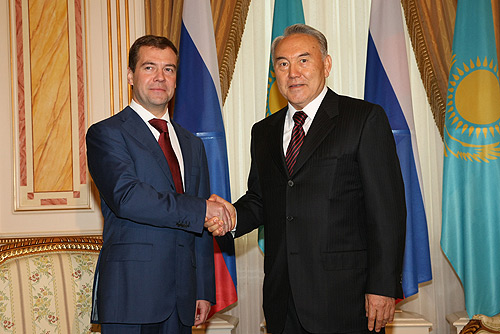
Dmitry Medvedev and Nursultan Nazarbayev in Astana, 2008 (courtesy of Wikipedia)

Kazakhstan promises to reform OSCE. Europe still hopes to democratize the entrenched authoritarian Kazakhstan. Who is under the bigger illusion?

Yesterday, Kazakhstan took up the chairmanship of the OSCE for the 2010-2011 mandate. The US manifested all its support to the new OSCE leaders and “stands ready to encourage your efforts to lead by example and reflect in practice the principles and provisions of the organization you now chair.” The Finnish foreign minister, whose country occupied this seat in 2008, explicitly stated his faith in the good intentions of the new team chairing the OSCE and even mentioned a possible reform of the organization concerning the European security. He believes in the Kazakhstan’s projects for the OSCE despite the fact that “none of the Central Asian countries are, I guess, perfect from a Western, democratic, rule-of-law perspective.” He also believes in the diplomatic ability of Kazakh leaders in bringing at the same table all OSCE members in order to reform the European security framework with the help of a recent plan endorsed by the Russian president Medvedev.

More…

Să apărăm democraţia! Pedepsiţi-l pe Ombudsman Răspunde

Până în acest moment ambele planuri propuse de Arias au eşuat, iar punctul unde cele două tabere devin intransigente este tocmai revenirea lui Zelaya în funcţia de preşedinte pentru următoarele luni. Zelaya nu concepe altă soluţionare a conflictului, pe când elită hondurana şi Micheletti, noul preşedinte numit de Congres, nu pot admite ca ceea ce ei numesc respectarea strictă a constituţiei şi protejarea principiului domniei legii să fie ignorate din cauza presiunii internaţionale. More…

Central and Eastern European fears 2

A group of Central and Eastern European intellectuals and former chiefs of state have published on July 16 an open letter to the President of the United States of America, voicing their concerns regarding the current state of relations between the countries of this region and the United States. The letter comes after the US-Russia summit and is signed by Vaclav Havel, Lech Walesa, Emil Constantinescu, Valdas Adamkus, Martin Butora, Matyas Eorsi, Alexandr Vondra and other important figures who have played a part in the recent history of Central and Eastern Europe. In the letter they emphasize the role played by the United States in Central Europe’s (CEE) transition from authoritarianism to democracy, remind Washington of the contribution made by the countries of this region to the American war effort in Iraq and Afghanistan, while deploring the fact that the CEE is no longer a priority for US foreign policy. The letter criticizes the new “realist” foreign policy of the Obama Administration concerning Europe and Russia, with the shadow of Yalta looming large in the minds of the signatories.

More…

An odd gesture Răspunde

Last week Romanian President Traian Băsescu refused to attend the reception hosted by the American embassy in Bucharest to celebrate the 4th of July. This is the first time since fall of communism that a Romanian president has refused to attend the celebration hosted by the embassy. It is an odd gesture coming from a president known for his pro-American stance. The official explanation of the Romanian Presidency concerning the absence of the president from the reception was that Traian Băsescu had a busy schedule on July 2nd. Instead Romanian Prime Minister Emil Boc, and the minister of Foreign Affairs Cristian Diaconescu both attended the reception along with a host of important Romanian personalities.

More…

The Austrian Embassy in Bucharest has sprung a leak Răspunde

I should start by saying that someone at the Austrian Embassy in Bucharest had a really bad day at the office this Sunday… In short it seems someone from the embassy’s staff has leaked a memo, written by Ambassador Martin Eichtinger in which he surmises Romania’s position on thorny diplomatic issues concerning energy security, EU-Russian relations and Turkey’s accession to the EU. The document reveals not only Romania’s foreign policy agenda and positions, but also possible future decisions the government will take in the near future regarding the Nabucco gas pipeline, the PEOP  project (Constanta-Trieste oil pipeline) the national energy security strategy, the current situation in Moldova, relations with Russia and Ukraine. All the informations in the leaked document are taken from statements which president Traian Basescu made to EU diplomats or from his meetings with various European and regional leaders. In essence the document is nothing more than a diplomatic report which every embassy has to send back home to the foreign ministry. This particular document was destined for the Austrian foreign ministry and for the Austrian embassies in Chisinau, Bruxelles, Kiev and Moscow.

More…

Nabucco’s future uncertain 3

German Chancellor, Angela Merkel, has declared today after the informal EU summit called by the current Czech Presidency of the European Union and the Presidency of the European Commission in concern with the effects of the economic crisis and possible remedies, that Germany is against any public funding for the Nabucco project. This means that any hopes for EU funds to help develop this alternative energy route have been dashed. Without German support it is doubtful than any funding will be released in order to give the go ahead for this long delayed pipeline that would have circumvented the Russian monopoly on gas deliveries to Europe.

More…

Romania’s Draft Foreign Policy “Strategy”: Does it really provide a Coherent Action Plan for Romania’s Diplomacy? 1

This is the second instalment from the series of articles regarding Romanian foreign policy I promised I will publish on this blog. In this article I will discuss and comment the draft 10 year foreign policy strategy which has been recently published by the Romanian Ministry of Foreign Affairs. Actually the word strategy does not properly describe the document – it is more a list of priorities and objectives for Romania’s diplomacy for the next ten years. In this respect the word strategy is a misnomer – but for practical purposes, I will refer to it as a strategy (the document is meant to ignite a public debate concerning Romania’s foreign policy in the next decade).

More…

Romania and Russia: conflict and cooperation 1

This article will deal with the current status of relations between Romania and Russia. I will argue that although there are issues when cooperation can occur between the two states, the opportunities for conflict far outweigh them.

One thing that must be cleared from the beginning is that the relation between the two countries is and was asymmetrical. This relationship is and has been asymmetrical because it involves a great power or a medium power (depending on the timeline) and a small power. Today Russia can be catalogued as an aspiring great power while Romania remains a small power (with a good prospect of becoming a regional power).

More…

Russia and the EU: Quo Vadis? 1

In this article I will argue that EU’s relations with the Russian Federation are at a crossroads, with the latter gaining leverage while the former has trouble finding an adequate response to this challenge.

The differences between two actors stem from two quite different perceptions of world politics and diplomacy. Russia sees international politics from a realist perspective emphasising power politics and strategic cooperation while the EU is advancing a post-Westphalian agenda of international politics based on shared norms and values. These different approaches and understandings of the international system have lead to an impasse in EU-Russian relation.

More…

Why Romania Requires a Modern Navy 3

Historically the Romanian Navy was not large but it played an instrumental part in the creation of the modern Romanian state. By maintaining a presence on the shores of the Black Sea as well as patrolling and policing the Danube River, a strategic and economically important European waterway, it maintained the sovereignty and independence of the state. More…

A tough Choice for Romania to Make : NATO or EU? 1

Apparently Romania is faced with a stark choice in terms of its foreign and security policies since it has joined the EU: should it continue with a foreign policy that emphasizes a strong atlanticist commitment or should it take a 180 degree turn towards a foreign policy oriented towards the EU?

I will argue that making such a choice now is senseless and that the Romanian government should develop a foreign policy that will emphasize both its strong NATO commitment (especially cultivating a strong relationship with the United States) as well as trying to better coordinate its foreign policy with EU member countries under the framework of the ESDP.

More…