Strategic Thinking and Foreign Policy in the European Union 6

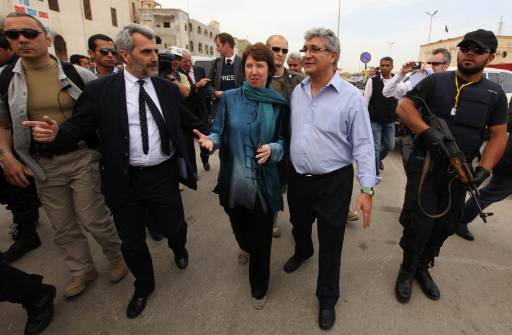
Catherine Ashton visiting war-thorn Benghazi

What EUrope is today increasingly depends on where one sits and assesses the situation.  I’m afraid this is quite a prosaic thing to say; an American will surely see a different thing in the EU than a Sub-Saharan African or an Asian. However dull this may sound Europe should consider applying this approach every time the question of a common European Union strategy in world affairs comes up.  What I mean by this can be considered to be a double-edged sword, as too much concern on how one sees you and what one wants from you may lead you to have doubts about your own identity.  But still, EU has enough doubts in this respect already, so maybe it is high time to try a thorough process of self-assessment through the eyes of others.
More…

Ronald Asmus: If the threats change, we must change how we defend ourselves against them Răspunde

Ronald Asmus (1957-2011)

How can you describe the present state of the transatlantic partnership? In early 2003, the notion used was the drift. Now, after president Bush’s second term it seems that we have a revived transatlantic alliance capable of projecting its power far beyond Europe and assuming global missions. On both sides of the Atlantic we have political elites with an advanced euro-Atlantic mindset. In this context, can NATO became once again a tool of first choice, a natural first choice since the alliance is the only interface between the euro-Atlantic societies and the threats of the XXI century? Or coalitions of the willing of NATO members (but not using NATO as a whole) would be a more realistically scenario because we are living in an article 4 world of discretionary commitments (Richard Haas)?

More…

Honoring the Mindset of A Generation: In Memory of Ronald Asmus Răspunde

Richard C. Hollbrooke (1941-2010) și Ronald D. Asmus (1957-2011)

Ronald Asmus was definitely, as Ivan Krastev highlighted in an article for opendemocracy.com, part of a generation “that emerged on the stage in the last days of the Cold War, it was baptized by the fall of the Berlin Wall, inspired by the thinking of dissidents and it never lost its belief in the transformative nature of democracy. It was a generation shaped by the end of the Cold War, the dilemmas of the Balkan wars and the success of the enlargement policy. It is a generation that came to importance at the moment when American power was at its height and American leadership was taken for granted”.

More…

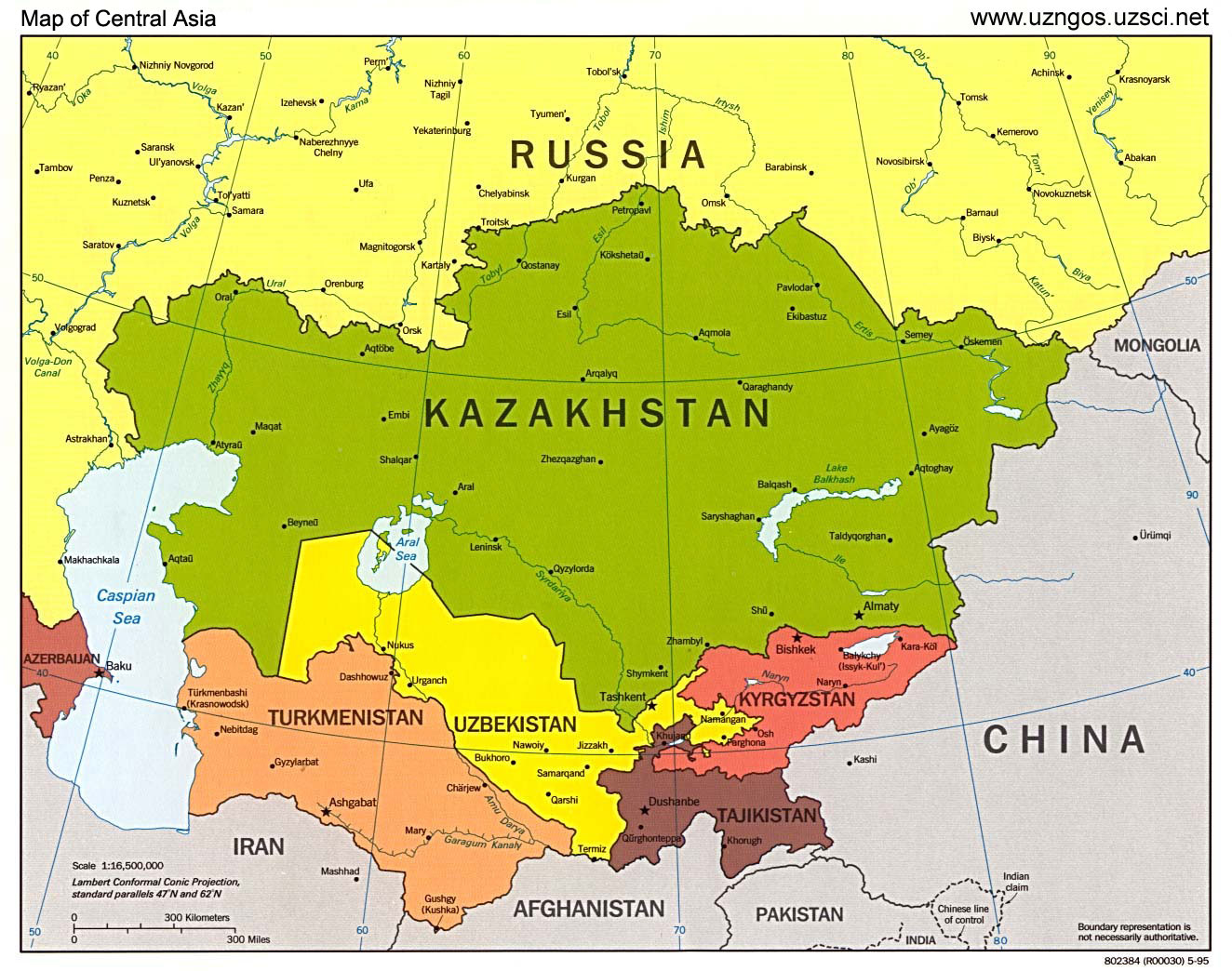
How useful is it to characterise the presence of foreign states in Central Asia as a new ‘Great Game’? 1

The States of Central Asia

The recent resurgence of the geopolitical and geostrategic importance of Central Asia (hereafter CA) has led to the re-adoption of the Great Game discourse[1], recalling the strategic rivalry which opposed the British Empire and the Russian Empire in the XIX century.

More…

Romanian Journal of European Affairs, vol. 11, no. 1, March 2011 Răspunde

The March 2011 issue of the Romanian Journal of European Affairs, vol. 11, no. 1 is now fully available online. Faithful to its scientific standards and in line with the current economic situation the journal brings into discussion important topics such as EU Economic Governance Reform: Are We at A Turning Point? by Daniel Dăianu and the need for a safe banking system with Deposit Guarantee Schemes Join Financial Safety-Net by Eugen Dijmărescu. Numbers do matter and statistical methods can prove themselves useful in analyzing the economics as proves Clara Volintiru in Economic Integration and Statist Reach – Towards a Holistic Assesment.

More…

The Weimar Triangle – Between a moderate regional success and an uncertain future Răspunde

Angela Merkel, Bronislaw Komorowsky and Nicolas Sarkozy

Where Does It Come From? What Is It? Where Is It Going?*

Motto: Tres faciunt collegium [three makes company]

The Weimar Triangle is soon to celebrate its twentieth anniversary. With a mixed record of relevance (due often to the leaders themselves) and a relatively strong level of cooperation as regards regional and local actors, it is in a process of redefinition. Through policies adopted at its February high level summit (EU budget, ESDP, etc.) and its prospective integration of Russia it might become a viable and highly influent organization at the European level.

More…

The Invisible Surge 1

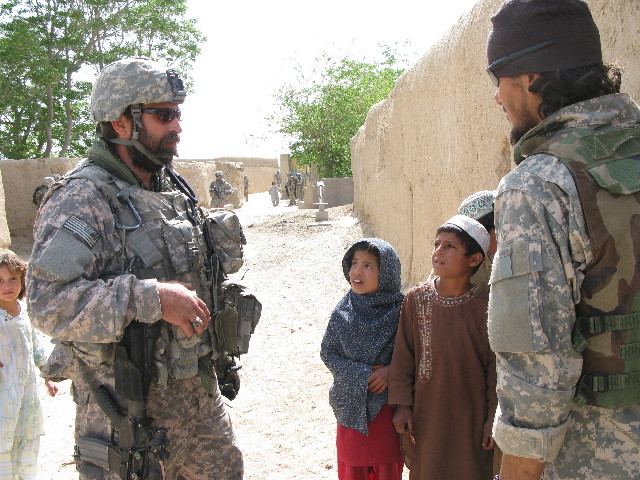
The nitty-gritty of counterinsurgency

Octavian Manea has put together this panel of experts in counterinsurgency and strategic studies in order to highlight some current trends concerning American and NATO counterinsurgency efforts in Afghanistan.

More…

NATO’s developments 1

In my opinion, one of the most interesting developments in the international politics scenario will be a massive change in the role, the identity and the purposes of NATO. Moreover, as the need for a new strategic plan becomes clearer, I suggest that this development will be both welcomed and inevitable, especially for the reasons I outlined below.

More…

Statecraft is stagecraft 2

Wess Mitchell

At the behest of my good friend and colleague, Octavian Manea, I am very pleased to re-publish on this blog his posting from Politică Externă. I hope you will find this post as useful and insightful as I did.

On October 8th, the Center for European Policy Analysis (a DC think tank dedicated to the study of geopolitical trends in Central Europe) launched a timely sensitive report on the topic of the Hingepoint Allies: Bolstering U.S. Alliances with Exposed States in Central Europe, East Asia and the Middle East. The authors – A. Wess Mitchell, Jakub Grygiel and Robert Kron – highlighted the strategic commonalities and the linkages facing small and mid-sized U.S. allies at global faultlines in Central Europe, East Asia and Middle East. The ongoing shifts in the regional power balances and the strategic choices made by local actors in these new settings point out to a possible medium term trend: ”the subtle but steady unraveling of U.S.-centered security orders at three of the world’s historically most strategically-vital regions”.

More…

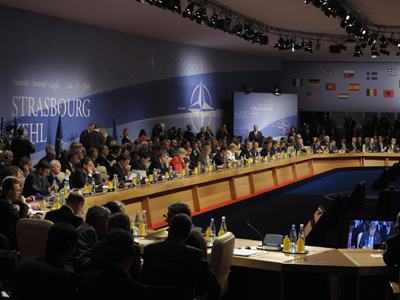
The blue-print of the future NATO strategic concept: future missions and capabilities Răspunde

I continue the presentation and analysis of the experts’ report on the future NATO strategic concept, an endeavor which I have began in May, with the section dedicated to the future missions and military affairs. The final section of the experts’ report deals with NATO’s future missions and the development of future military capabilities required to fulfill them.  Section five of the report provides an analysis of the current needs and capabilities and makes recommendations on what missions and capabilities should be provided in the future strategic concept of the Alliance.

More…

The blue-print of the future NATO strategic concept: organizational and political issues 1

Three months a go I have published on this blog an analysis of the experts’ report concerning the future NATO strategic concept to be adopted in Lisbon, in late 2010. That analysis dealt mainly with general comments and observations concerning the threat environment, NATO’s core tasks and partnerships. The second installment of the analysis of the experts’ report on the future NATO’s strategic concept will deal with political and organizational issues.

More…

The blue-print of the future NATO Strategic Concept: Some comments and views 2

NATO has released last week a report containing the outline of the future NATO Strategic Concept that will be adopted at the Alliance summit this year in Lisbon. Although this is not even a draft of the new Strategic Concept, it is a blue print that offers a glimpse of NATO’s strategic thinking. Following its publication  consultations and heated negotiations between member states will follow in order to draft the NATO’s new Strategic Concept. This article is first in a series dedicated to analyzing the outline of the Alliance’s future strategy. In this part I will summarize and analyze the chapters dedicated to the threat environment, core tasks of NATO and partnerships.

More…