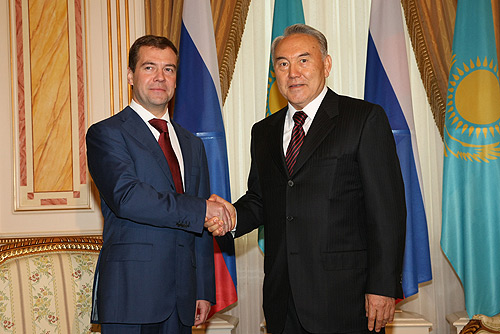
The last week’s visit to France of Russian president Dmitry Medvedev has further strengthen Franco-Russian relations, while at the same time endangering European security. During this visit France and Russia concluded a series of economic agreements concerning the energy market (GDF Suez wil participate in the Nord Stream pipeline project), a partnership between the French rail company Alstom and its Russian counterpart TMH and opened exclusive talks on buying four Mistral class amphibious assault ships (LHD). Although France has not yet decided to sell the ships, this military deal seems almost certain and the bilateral talks between France’s president Nicolas Sarkozy and his Russian counterpart, Dmitry Medvedev seem to confirm that few details remain to be settled before the green light is given.
Tag Archives: Russia
Ukraine: Political Stability in Question after the Presidential Elections Răspunde
Ileana Racheru has interviewed the regretted Ukrainian political analyst Roman Kupchinsky. Roman Kupchinsky was the editor of the Ukrainian language publishing house and research company Prolog Research Corp. Between 1990 and 2002 he was Director of the Ukrainian service of Radio Free Europe / Radio Liberty and senior analyst for the same institution between 2002 and 2008. Mr. Kupchinsky died of cancer this year on January 19, aged 66. This interview may be the last he ever gave.
The interview has also been published in Romanian in 22 Magazine and in English on Politică Externă blog.
How do you describe the Ukrainian electorate and the electoral programs of the main candidates? What groups of interest are behind each important candidate?
Romania will host elements of the US missile shield 3
Romania’s President, Traian Băsescu has announced yesterday the willingness of his country to host parts of US the ballistic missile defense system on its territory. The decision to allow the United States to deploy anti-ballistic missiles in Romania was taken in a meeting of the Supreme Defense Council (CSAT). According to Traian Băsescu Mrs. Ellen Tauscher the Under Secretary of State for Arms Control and International Security has formally proposed on behalf of the United States of America that Romania should host on its territory an anti-ballistic missile system. The US State Department has confirmed the agreement while the US embassy in Bucharest has saluted president Băsescu’s decision. Following the CSAT decision bilateral negotiations will be started, however the final approval for the deployment of the missiles must come from the Romanian parliament. The Romanian president has stated that the missile shield is not directed against Russia, but is designed to protect against other threats.
Kazakhstan’s big plans for OSCE. Let’s hope not 4
Kazakhstan promises to reform OSCE. Europe still hopes to democratize the entrenched authoritarian Kazakhstan. Who is under the bigger illusion?
Yesterday, Kazakhstan took up the chairmanship of the OSCE for the 2010-2011 mandate. The US manifested all its support to the new OSCE leaders and “stands ready to encourage your efforts to lead by example and reflect in practice the principles and provisions of the organization you now chair.” The Finnish foreign minister, whose country occupied this seat in 2008, explicitly stated his faith in the good intentions of the new team chairing the OSCE and even mentioned a possible reform of the organization concerning the European security. He believes in the Kazakhstan’s projects for the OSCE despite the fact that “none of the Central Asian countries are, I guess, perfect from a Western, democratic, rule-of-law perspective.” He also believes in the diplomatic ability of Kazakh leaders in bringing at the same table all OSCE members in order to reform the European security framework with the help of a recent plan endorsed by the Russian president Medvedev.
US makes major strategic shift on Missile Defense 3

A ground-based interceptor lifts off from Vandenberg Air Force Base, Calif., Dec. 5, 2008. (DoD photo by Joe Davila, U.S. Air Force/Released)
The President of the United States, Barack Obama has announced on September 17, a major shift in the policy of the US concerning the deployment of anti-ballistic missile defenses in Central and Eastern Europe in order to protect its European allies from a possible Iranian threat. In this article I will argue that this move is a part of a larger strategy of retrenchment, designed to make American power more flexible and adaptable in an international system defined both by symmetrical and asymmetrical threats. The move does not signal by any means a waning of America’s commitment to Europe’s security or for that matter, the security of Central and Eastern Europe. Canceling the deployment of the Ground Based Interceptors in Poland and the X band radar in the Czech Republic does not mean the United States is giving up on creating a national missile defense capability.
Central and Eastern European fears 2
A group of Central and Eastern European intellectuals and former chiefs of state have published on July 16 an open letter to the President of the United States of America, voicing their concerns regarding the current state of relations between the countries of this region and the United States. The letter comes after the US-Russia summit and is signed by Vaclav Havel, Lech Walesa, Emil Constantinescu, Valdas Adamkus, Martin Butora, Matyas Eorsi, Alexandr Vondra and other important figures who have played a part in the recent history of Central and Eastern Europe. In the letter they emphasize the role played by the United States in Central Europe’s (CEE) transition from authoritarianism to democracy, remind Washington of the contribution made by the countries of this region to the American war effort in Iraq and Afghanistan, while deploring the fact that the CEE is no longer a priority for US foreign policy. The letter criticizes the new “realist” foreign policy of the Obama Administration concerning Europe and Russia, with the shadow of Yalta looming large in the minds of the signatories.
An odd gesture Răspunde
Last week Romanian President Traian Băsescu refused to attend the reception hosted by the American embassy in Bucharest to celebrate the 4th of July. This is the first time since fall of communism that a Romanian president has refused to attend the celebration hosted by the embassy. It is an odd gesture coming from a president known for his pro-American stance. The official explanation of the Romanian Presidency concerning the absence of the president from the reception was that Traian Băsescu had a busy schedule on July 2nd. Instead Romanian Prime Minister Emil Boc, and the minister of Foreign Affairs Cristian Diaconescu both attended the reception along with a host of important Romanian personalities.
Coreea de Nord a efectuat astăzi un nou test nuclear Răspunde
Coreea de Nord a reuşit astăzi să surpindă comunitatea internaţională cu un nou test nuclear. Dacă primul test nuclear efectuat de acest stat pe 9 octombrie 2006 a fost anunţat, testul de astăzi a fost efectuat fără emiterea nici unui avertisment. Autorităţile de la Phenian au ameninţat însă pe 29 aprilie că vor efectua un nou test nuclear, dacă Consiliu de Securitate al ONU nu ridică sancţiunile împotriva Republicii Democrate Populare Coreea şi nu prezintă scuze. Explozia a fost detectată de catre către USGS (Serviciul pentru Studii Geologice şi Seismice al SUA) care a detectat un mic cutremur de 4,7 grade pe scara Richter în proximitatea locaţiei primului test nuclear. Nu se cunoaşte puterea exactă acestui nou test nuclear – ministerul rus al apărării a emis o estimare a puterii dispozitivului nuclear cuprinsă între 10 şi 20 de kilotone. Testul anterior din 2006 a fost estimat de specialişti ca având echivalent cu 1000 de tone de TNT (insuficient din punct de vedere militar).
The Austrian Embassy in Bucharest has sprung a leak Răspunde
I should start by saying that someone at the Austrian Embassy in Bucharest had a really bad day at the office this Sunday… In short it seems someone from the embassy’s staff has leaked a memo, written by Ambassador Martin Eichtinger in which he surmises Romania’s position on thorny diplomatic issues concerning energy security, EU-Russian relations and Turkey’s accession to the EU. The document reveals not only Romania’s foreign policy agenda and positions, but also possible future decisions the government will take in the near future regarding the Nabucco gas pipeline, the PEOP project (Constanta-Trieste oil pipeline) the national energy security strategy, the current situation in Moldova, relations with Russia and Ukraine. All the informations in the leaked document are taken from statements which president Traian Basescu made to EU diplomats or from his meetings with various European and regional leaders. In essence the document is nothing more than a diplomatic report which every embassy has to send back home to the foreign ministry. This particular document was destined for the Austrian foreign ministry and for the Austrian embassies in Chisinau, Bruxelles, Kiev and Moscow.
Nabucco’s future uncertain 3
German Chancellor, Angela Merkel, has declared today after the informal EU summit called by the current Czech Presidency of the European Union and the Presidency of the European Commission in concern with the effects of the economic crisis and possible remedies, that Germany is against any public funding for the Nabucco project. This means that any hopes for EU funds to help develop this alternative energy route have been dashed. Without German support it is doubtful than any funding will be released in order to give the go ahead for this long delayed pipeline that would have circumvented the Russian monopoly on gas deliveries to Europe.
Romania’s Black Sea Offensive Răspunde
Un nou articol al lui George Visan în publicaţia Central Europe Digest a institutului de cercetare Center for European Policy Analysis (CEPA) din Washington, despre reacţia diplomatică a preşedintelui României la conflictul dintre Rusia şi Georgia şi rolul pe care acesta ar vrea să şi-l asume în politica regiunii.
Cititi articolul complet în Central Europe Digest
Geoeconomia războiului dintre Rusia şi Georgia Răspunde
Bogdan Enache scrie în Săptămâna Financiară despre recentul conflict dintre Georgia şi Rusia. Potrivit lui Bogdan, cheia conflictului este controlul rutelor de transport al petrolului şi gazului din zona caspică.